
You are using an out of date browser. It may not display this or other websites correctly.
You should upgrade or use an alternative browser.
You should upgrade or use an alternative browser.
focus and recomposing
- Thread starter qwertok
- Start date

Turbonetics
Senior Member
@ one eye jack
Thax for explaining. Understand about the metering part.
I'm juz confused over why TS associated metering with focusing... Aren't they 2 separate things?
iam confuse too,but i am with u.
TS asked if he recompose and the part(eye) he originally focus on will be OOF,which should not be true(provided he is not on AI Servo mode).
as mentioned by u if the distance never change.
iam confuse too,but i am with u.
TS asked if he recompose and the part(eye) he originally focus on will be OOF,which should not be true(provided he is not on AI Servo mode).
as mentioned by u if the distance never change.
I understand that the distance never change, but the angle change? because u tilted the camera? I am confused with this part as well, thats why i wanted to clarify with the experts.
so... is it true? i thought most of the previous replies said that it is true for thin DOF?
like there will be a circumference that will be "blurred" and even if you do not move from your spot and just tilt the angle of the camera, it will "shift" the circumference of that "blurred" area and thus causing the part (in this case eye) to be OOF?
one eye jack
Senior Member
I understand that the distance never change, but the angle change? because u tilted the camera? I am confused with this part as well, thats why i wanted to clarify with the experts.
We are not experts but normal people who have learnt and studied photography just like you.

When you tilt the camera (change of angle) there is a slight change in distance.Remember your geometry lesson of the triangle?
so... is it true? i thought most of the previous replies said that it is true for thin DOF?
This is the mechanics of the focus mechanism/sensor and software or firmware as it is called.It is sensitive to small changes in contrast(the difference between bright and dark ) or light intensity sensed.Of course if large aperture like F2.8 DOF is shorter tendency to get out of focus but focus mechanism do not "see" it like this it only detect changes in overall light intensity so if you shift camera angle of view that means the picture overall light intensity changes because different objects or part of scene change.
like there will be a circumference that will be "blurred" and even if you do not move from your spot and just tilt the angle of the camera, it will "shift" the circumference of that "blurred" area and thus causing the part (in this case eye) to be OOF?
If I understand your writing, there is no circumference as there are no circle (except for that in your viewfinder) although in reality
the lens is round and actual image is round but the sensor frame is rectangle so anything outside rectangle is not captured.
You are really describing the method of helping the camera to focus by picking a high contrast area/spot like the eye.I think maybe you are talking about film camera with spilt screen or circle in the viewfinder.Also know that in digital camera the focusing screen in the viewfinder is a lens known as fresnel lens which have circular steps cut into the glass which may give the impression of circular blur as you tilt the camera but that's the properties of fresnal lens.It does not affect the picture at all,it just helps you see or discern the difference of contrast easier I think. You have sound/beep as well as light indicator for focus confirmation.Hope I got your meaning.
Fresnel lens - Wikipedia, the free encyclopedia
Fresnel Lenses - Edmund Optics
center point focus-it works
http://photo.tutsplus.com/articles/theory/mastering-two-alternate-focus-techniques/
center point focus- it sucks/does not work
http://visual-vacations.com/photography/focus-recompose-sucks.htm
How to manage autofocus
http://www.dantestella.com/technical/afblues.html
Last edited:

then u better know your DoF tables and hyperfocal distances at different focal lengths for your sensor size well if you want to meter one spot, focus on another spot and THEN radically recompose the scene
If you are just re-composing the subject a little to the side, the difference should be well within the DoF parameters for that givn aperture you have decided on ..... unless of course you are shooting WIDE open (eg f1.8, 1,4 or even wider) and up close (where then my first sentence above applies) and the camera set up will need to be catered for these special circumstances eg compose FIRST then without moving camera do manual focus or practice 'imaginary equidistance planes/lines of focus to subject etc etc
lots of ways to skin that cat when DoF is razor thin
If you are just re-composing the subject a little to the side, the difference should be well within the DoF parameters for that givn aperture you have decided on ..... unless of course you are shooting WIDE open (eg f1.8, 1,4 or even wider) and up close (where then my first sentence above applies) and the camera set up will need to be catered for these special circumstances eg compose FIRST then without moving camera do manual focus or practice 'imaginary equidistance planes/lines of focus to subject etc etc
lots of ways to skin that cat when DoF is razor thin

ZerocoolAstra
Senior Member
I understand that the distance never change, but the angle change? because u tilted the camera? I am confused with this part as well, thats why i wanted to clarify with the experts.
so... is it true? i thought most of the previous replies said that it is true for thin DOF?
like there will be a circumference that will be "blurred" and even if you do not move from your spot and just tilt the angle of the camera, it will "shift" the circumference of that "blurred" area and thus causing the part (in this case eye) to be OOF?
I found this image to be quite a good and simple explanation for why sometimes focus-recompose will yield issues with subjects appearing less than perfectly sharp.
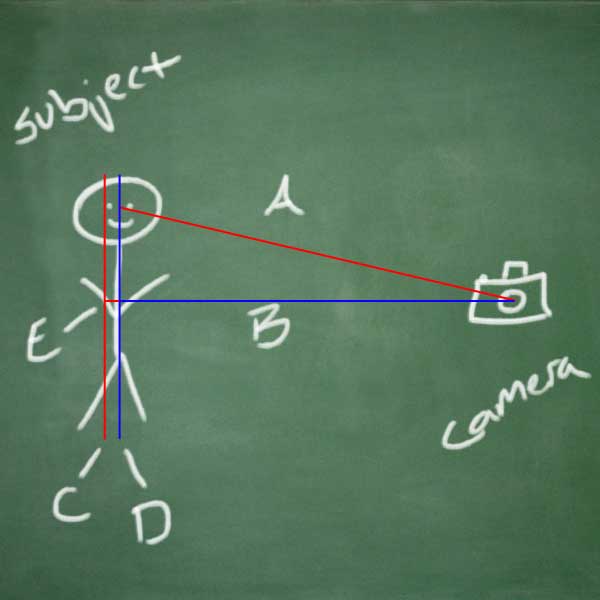
http://www.digital-photography-school.com/wp-content/uploads/2011/08/focusrecomposediagram.jpg
I found this image to be quite a good and simple explanation for why sometimes focus-recompose will yield issues with subjects appearing less than perfectly sharp.
http://www.digital-photography-school.com/wp-content/uploads/2011/08/focusrecomposediagram.jpg
Shouldn't the plane of focus be always perpendicular to the incident which is not reflected in the recomposed incident?
Actually to be exact, it's more accurate to refer the plane of focus as sphere of focus. Plane of focus is as a concept is easier to understand assuming recomposing involves only rotational movements. Sphere of focus would be involved if it includes translational movement during recomposition. This is in theory, but in practice its based on your subjective tolerance to DoF, isn't it?
ZerocoolAstra
Senior Member
CamInit said:Shouldn't the plane of focus be always perpendicular to the incident which is not reflected in the recomposed incident?
Actually to be exact, it's more accurate to refer the plane of focus as sphere of focus. Plane of focus is as a concept is easier to understand assuming recomposing involves only rotational movements. Sphere of focus would be involved if it includes translational movement during recomposition. This is in theory, but in practice its based on your subjective tolerance to DoF, isn't it?
No leh. I believe the camera focuses in a plane. Hence if you were to hang a giant grid pattern on a wall and photograph at a perpendicular angle to the wall, the grid (in theory) should be in focus.
It's the rotational movement of the camera during focus-recompose that causes this problem, am I right?
I think I'm confusing myself here

too lazy to scan and post my old notes from the 70s but u can read pretty much the same thing here on Circle of Confusion to help you (ironically) understand what is meant by being 'in focus' from a DoF perspective
Circle of confusion
Circle of confusion
No leh. I believe the camera focuses in a plane. Hence if you were to hang a giant grid pattern on a wall and photograph at a perpendicular angle to the wall, the grid (in theory) should be in focus.
It's the rotational movement of the camera during focus-recompose that causes this problem, am I right?
I think I'm confusing myself here
Argh...!! I was writing a lengthy reply and close the tab by accident! Too tired to rewrite everything... I found the source article for the diagram here. If you read the comments, some readers have issues with the article and hence the diagram might lead to wrong ideas without providing the context.
This is what I understand: Yes, the grid (as in focal plane) will be in focus due to lens designers minimizing field curvature. However, I don't see how it help in recomposition when rotating/tilting the camera traces out a spherical locus of focus points.
Think there might be terminology issues in my earlier post... It's 2:15am and I can't recall the rest of what I wrote so I provide a link which I hope would be able to deal with the subject far better than I could:
Focus and Recompose

Prince Photogenic
New Member
sinned79 said:manual focus is not that tough (with the aid of a split screen focusing screen). unless u need to be quick in your shots.
I've been using autofocus, but heard there's some device to give u the beep when you managed to focus..
ZerocoolAstra
Senior Member
Argh...!! I was writing a lengthy reply and close the tab by accident! Too tired to rewrite everything... I found the source article for the diagram here. If you read the comments, some readers have issues with the article and hence the diagram might lead to wrong ideas without providing the context.
This is what I understand: Yes, the grid (as in focal plane) will be in focus due to lens designers minimizing field curvature. However, I don't see how it help in recomposition when rotating/tilting the camera traces out a spherical locus of focus points.
Think there might be terminology issues in my earlier post... It's 2:15am and I can't recall the rest of what I wrote so I provide a link which I hope would be able to deal with the subject far better than I could:
Focus and Recompose
Sorry to hear that the tab closed prematurely
Thanks for taking the trouble to find the link. Am reading through it and I do agree with the points.
Guess I need to test it out in order to convince myself
Prince Photogenic
New Member
Use focus peaking.
A33 bo focus peaking leh..

kei1309
Senior Member
ZerocoolAstra said:No leh. I believe the camera focuses in a plane. Hence if you were to hang a giant grid pattern on a wall and photograph at a perpendicular angle to the wall, the grid (in theory) should be in focus.
It's the rotational movement of the camera during focus-recompose that causes this problem, am I right?
I think I'm confusing myself here
When you recompose, the distance to the intended area of focus changes and the subject or intended area of focus might not be in the plane of focus any longer.
And don't bluff. How can the legendary ZCA be confused? :bsmilie:

sinned79
Senior Member
I've been using autofocus, but heard there's some device to give u the beep when you managed to focus..
that is the focus confirmation chip... that will sends canon camera beeping when subject in focus.
i dun really use this beep feature on my canon camera even if i am using an AF lens cos it is very distracting.
its really not tough to do manual focusing. like i mention earlier, if you are using a split focusing or precision focusing screen, when u slowly turn the focusing ring, at one point, everything will comes to "life".
but i wun recommend you to use manual focusing if you are doing a commercial job unless u are using zone focusing.
ZerocoolAstra
Senior Member
When you recompose, the distance to the intended area of focus changes and the subject or intended area of focus might not be in the plane of focus any longer.
And don't bluff. How can the legendary ZCA be confused? :bsmilie:
evil... laugh at me :devil:
I think I got my thoughts jumbled up. The point about the 'sphere of focus' does make some sense to me, which got me thinking... and ultimately confused
Prince Photogenic
New Member
that is the focus confirmation chip... that will sends canon camera beeping when subject in focus.
i dun really use this beep feature on my canon camera even if i am using an AF lens cos it is very distracting.
its really not tough to do manual focusing. like i mention earlier, if you are using a split focusing or precision focusing screen, when u slowly turn the focusing ring, at one point, everything will comes to "life".
but i wun recommend you to use manual focusing if you are doing a commercial job unless u are using zone focusing.
I see i see.. Thanks, I'll go try sometime. hehe =)
When I first started photography, my flim point and shoot had one focus point. Reading through the manual I learned to focus then then recompose. Later as I progressed, I learned to use the AE lock button, I would set the exposure then focus then compose. Till today I am still using the same method usually fixing my focus point to the centre point.
Last edited:

Stoppable said:When I first started photography, my flim point and shoot had one focus point. Reading through the manual I learned to focus then then recompose. Later as I progressed, I learned to use the AE lock button, I would set the exposure then focus then compose. Till today I am still using the same method usually fixing my focus point to the centre point.
It works well for pns because the aperture is much smaller and the dof is deep enough. You will start running into problems when shooting big aperture lenses wide open like f1.8 or f1.4
Of course the p&s was only my first camera. My first encounter with multi focus points was my last flim dslr. An eos 50e, it had 3. Couldn't figure why I would let the camera decide my focus point. Nowadays I do sometimes shoot at 1.4 but have accept some softness anyway.
Similar threads

- Replies
- 0
- Views
- 213
- Replies
- 0
- Views
- 291
- Replies
- 0
- Views
- 249
- Replies
- 0
- Views
- 2K
- Replies
- 0
- Views
- 584