Konica Hexanon M Lenses


Status
Not open for further replies.
No. Recently bought one from evilBay:) Very very nice. Must compare to my friend's Noctilux when I get back again.

So you beat me to it? You got it via Prime? :cry:
 

I am new in manual cameras and really hope some pros here can answer my question regarding konica hexanon lenses?

I received a konica T3n with a hexanon 50mm f1.4 and 28mm f3.5 as a gift.
I love it.
may I ask if I am able to buy Leica lens to mount on my t3n??
And is there any 3rd party products that can help me to mount my hexanon lens onto my nikon D200?
Thank you so very much!
:D

No, this is not the M-mount. There are only a few M-mount lenses, 28, 35 (M and UC versions), 50 (f2 and f1.2), 60, 90 and the 21-35mm before they got discontinued.

Photodo MTF measurements show M-Hexanon 50f2 at 4.5 vs Summircron f2 4.6 vs Noctilux and Summilux 4.2 (higher is better).
 

thank you very much! =)
 

Welcome to the RF club.
 

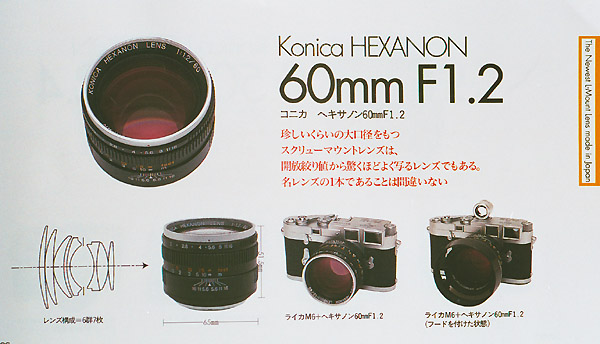
One rare Hexanon on eBay. Hexanon 60mmf1.2 - 800 pieces made only. Those who want quick.....
http://cgi.ebay.com/Konica-HEXANON-...hZ006QQcategoryZ30063QQtcZphotoQQcmdZViewItem

I hope you are enjoying yours. I managed to dig up some info on this lens by Erwin Puts. Somehow, not much on the Hexanon 60mm f1.2:

http://leica-users.org/v10/msg02766.html

"Through the Hexanon 1.2/60mm at full aperure flows less energy than through the Noctilux 1.0/50mm. In fact the Hexanon at 1,2 is equal to the Noctilux at f/1.4. When comparing the two lenses at their full aperture, one should be aware of the fact that it is a f/1.0 against f/1.4 game.

On test the Hexanon at full aperture produced medium to high overall contrast with excellent on axis performance. Very fine detail is clearly recorded, but tangentially oriented structured are recorded very softly. The overall effect of both orientations would be a softening of the contrast of fine detail. In the field chromatic aberrations can be detected as color fringes around the edges of outlines. Some curvature of field is also noticeable. The on axis performance extends over a circle with a diameter of about 8mm. Beyond this circle, image quality rapidly falls away, and in a small zone beyond the 8mm area, fine detail has good visibility with a low contrast. In the outer zones and far edges the outlines of bigger objects are quite fuzzy.

At a focus distance of 1 meter, this general behavior holds, but contrast drops over the whole image field. Some of the lens-elements of the Hexanon are large and have very thin edges. I could note some decentring. The report is based on the correct centring."
 

I think the Hexanon60f1.2 referred to in the article is the original one. This current limited edition one may be different in design & coating.:dunno:

I hope you are enjoying yours. I managed to dig up some info on this lens by Erwin Puts. Somehow, not much on the Hexanon 60mm f1.2:

http://leica-users.org/v10/msg02766.html

"Through the Hexanon 1.2/60mm at full aperure flows less energy than through the Noctilux 1.0/50mm. In fact the Hexanon at 1,2 is equal to the Noctilux at f/1.4. When comparing the two lenses at their full aperture, one should be aware of the fact that it is a f/1.0 against f/1.4 game.

On test the Hexanon at full aperture produced medium to high overall contrast with excellent on axis performance. Very fine detail is clearly recorded, but tangentially oriented structured are recorded very softly. The overall effect of both orientations would be a softening of the contrast of fine detail. In the field chromatic aberrations can be detected as color fringes around the edges of outlines. Some curvature of field is also noticeable. The on axis performance extends over a circle with a diameter of about 8mm. Beyond this circle, image quality rapidly falls away, and in a small zone beyond the 8mm area, fine detail has good visibility with a low contrast. In the outer zones and far edges the outlines of bigger objects are quite fuzzy.

At a focus distance of 1 meter, this general behavior holds, but contrast drops over the whole image field. Some of the lens-elements of the Hexanon are large and have very thin edges. I could note some decentring. The report is based on the correct centring."
 

I think the Hexanon60f1.2 referred to in the article is the original one. This current limited edition one may be different in design & coating.:dunno:

Article written in 1999, lens launched in 1999. Not sure why Erwin would want to test older lenses. Normally, he wants to test the competitors to Leica. I could be wrong.
 

One advantage of the 60mm over the Noctilux is the focusing distance, 0.8m for the Hexanon vs 1.0m for the Nocti.
 

Apology for OT.

Found a nice review of the famous W-Nikkor 35mm F1.8 RF lens on which the UC-Hexanon 35mm is said to be based.

The design was done by a famous japanese lens designer Azuma in the year 1955, using only abacus and log table. The fact that his design resurface some 50 years later speaks volume about his talent:thumbsup:

YOL

Adding to the body of knowledge on the Hexanon 35mm:

http://konicaminolta.jp/about/research/technology_report/1993/pdf/8.pdf

EXCERPT:

"The main difference between Hexanon 35/2 and W-Nikkor 35/1.8 is that the second and third elements are separated in Hexanon. This gives greater negative power to the front group of the Hexanon, which allowed slightly larger spacing between the front and rear groups, in which the electronic shutter and diaphragm assembly were placed. (That is, Hexar AF needed some extra space to pack lens shutter and electronic motors to drive the shutter and aperture diaphragm, and this is reflected in the Hexanon lens design.)
Another difference between Hexanon and W-Nikkor is that the last surface (the rear surface of the cemented group) is negative in W-Nikkor and positive in Hexanon. This last group is placed behind a Xenotar-type lens to correct for coma, spherical aberration, field flatness and other important factors as the whole system. It is very likely that Konica engineers redistributed the balance of positive and negative powers in the rear group as well, and also optimized for aberrations in a slightly different way."

Technical report is here:

http://silvergrain.org/wiki/Konica_Hexar
 

Adding to the body of knowledge on the Hexanon 35mm:

http://konicaminolta.jp/about/research/technology_report/1993/pdf/8.pdf

...

Technical report is here:

http://silvergrain.org/wiki/Konica_Hexar

Quote from the above tech report:

"The sperical aberration of Hexanon 35mm f/2.0 is undercorrected to ensure crisp high contrast image from f/2 wide open. This is a very unique point of this lens design. Most rangefinder and SLR cameras fully correct or even overcorrect for sherical aberration so that the plane of focus does not move when the lens is stopped down. Hexar AF, on the other hand, can calculate the focus offset for each aperture value and correct for the focusing error during exposure. "

Does it means that the LTM UC-Hexanon 35mm/2, being a manual RF focus lens, would have foucs shift probelm when the lens is stopped down? (like the infamous ZM 50/1.5 sonnar) :dunno:

YOL
 

Quote from the above tech report:

"The sperical aberration of Hexanon 35mm f/2.0 is undercorrected to ensure crisp high contrast image from f/2 wide open. This is a very unique point of this lens design. Most rangefinder and SLR cameras fully correct or even overcorrect for sherical aberration so that the plane of focus does not move when the lens is stopped down. Hexar AF, on the other hand, can calculate the focus offset for each aperture value and correct for the focusing error during exposure. "

Does it means that the LTM UC-Hexanon 35mm/2, being a manual RF focus lens, would have foucs shift probelm when the lens is stopped down? (like the infamous ZM 50/1.5 sonnar) :dunno:

YOL

If the UC-Hexanon is based on the Nikkor 35mm f1.8 design, then there is no issue. I have seen tests and samples where at f4 and smaller, it is as sharp as the Cron.
 

If the UC-Hexanon is based on the Nikkor 35mm f1.8 design, then there is no issue. I have seen tests and samples where at f4 and smaller, it is as sharp as the Cron.

But the UC-Hexanon is of the same optical design as the one on Hexar AF, rite?
ie. it is not the same as the W-Nikkor 35/1.8, but a variant of it.
 

But the UC-Hexanon is of the same optical design as the one on Hexar AF, rite? ie. it is not the same as the W-Nikkor 35/1.8, but a variant of it.

"The main difference between Hexanon 35/2 and W-Nikkor 35/1.8 is that the second and third elements are separated in Hexanon". This was necessary as the Nikkor sits too far back if mounted on a Leica. Other than that, it has the same elements and groups.
 

2237710574_b163f895e8_o.jpg
 

Status
Not open for further replies.
Back
Top